What Is Advent, and How Do Catholics Keep It?
The word means coming. For about four weeks the Church gets ready for Christmas, and also for the day Christ will come again.
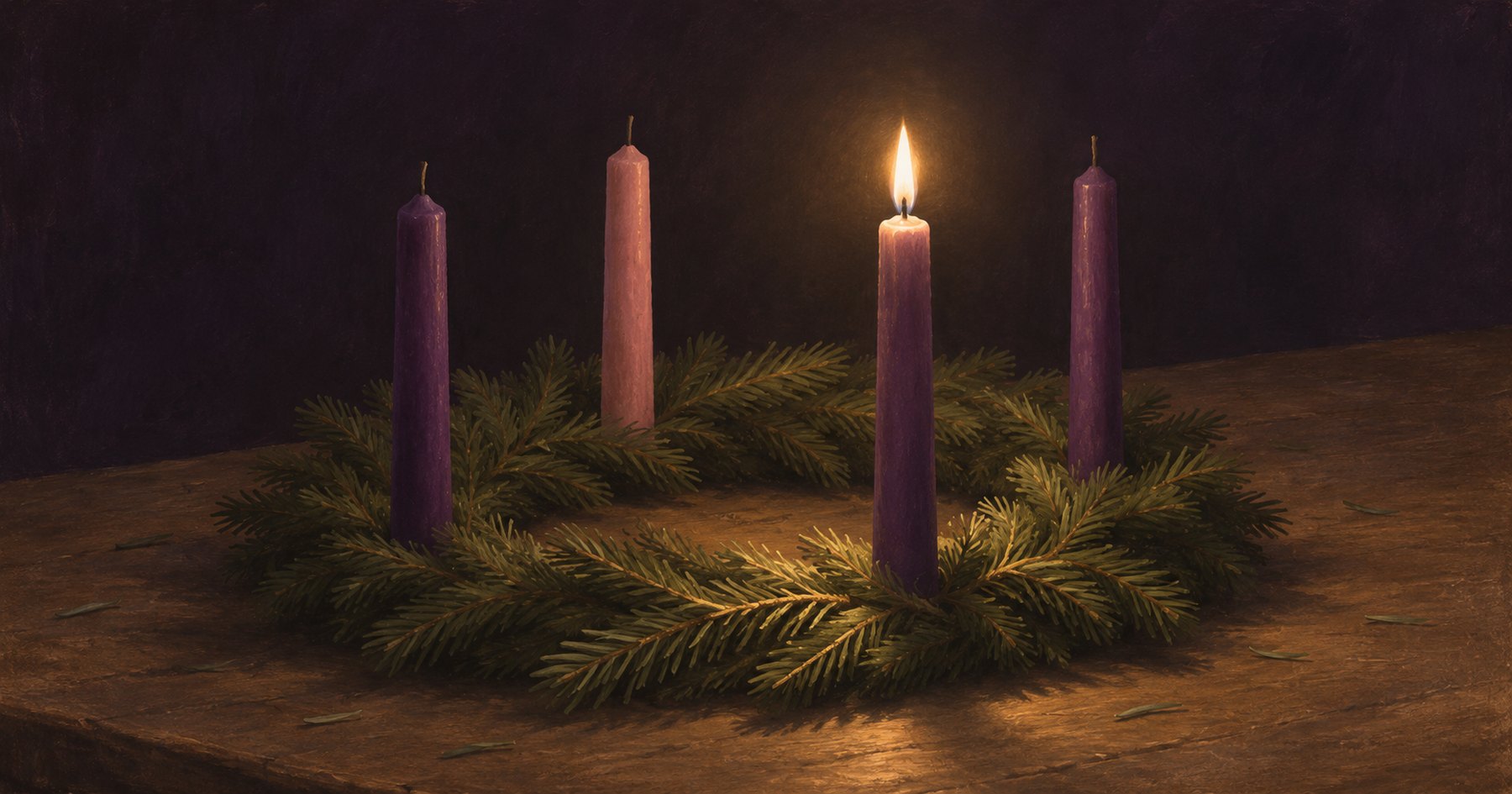
Advent is the season of the Church’s year that comes before Christmas. It begins on the fourth Sunday before Christmas and ends on Christmas Eve. In 2026, the First Sunday of Advent is November 29.
The name comes from the Latin adventus, which means “coming” or “arrival.” Advent is also the start of the Church’s year. The cycle of seasons and feasts that runs through Christmas, Lent, Easter and the long weeks of Ordinary Time begins again on the First Sunday of Advent.
Two comings
Advent looks in two directions. The Church’s rules for the liturgical year describe it this way: it is a time to prepare for Christmas, when Christ’s first coming is remembered, and that remembrance turns our minds to his second coming at the end of time. For both reasons, they call Advent a time of devout and joyful expectation.
The readings at Mass follow that order. The First Sunday of Advent is about the end of time, and its Gospel is always a warning to stay awake. In 2026 it comes from St. Mark: “And what I say to you, I say to all: Watch.” The second and third Sundays turn to St. John the Baptist, preaching in the desert and telling the people to prepare the way of the Lord. The fourth Sunday turns to Mary and Joseph and the events just before the birth. The first readings come from the prophets, most often Isaiah.
On December 17, the season changes pace. From then until Christmas Eve, the readings at weekday Mass go straight to the events before the Nativity: the genealogy of Jesus, the angel’s visits to Joseph and to Mary, the birth of John the Baptist.
When it begins and ends
Advent always has four Sundays, but it is not always the same length. The First Sunday of Advent is the Sunday closest to the feast of St. Andrew on November 30, so it falls between November 27 and December 3. Advent ends on Christmas Eve, and it can last anywhere from twenty-two days to twenty-eight.
In 2026, Christmas falls on a Friday, so Advent lasts twenty-six days:
- First Sunday of Advent: November 29
- Second Sunday: December 6
- Third Sunday, Gaudete Sunday: December 13
- Fourth Sunday: December 20
- Christmas Eve: Thursday, December 24
The Sunday readings also run on a three-year cycle, and each new cycle begins with Advent. In the year that begins on November 29, 2026, most of the Sunday Gospels will come from St. Mark.
Where Advent came from
No one knows exactly when Christians began to keep a season before Christmas. One of the earliest signs comes from Spain. In 380, a council of bishops at Saragossa ruled that from December 17 until the Epiphany, no one should stay away from church.
In Gaul, the season grew into a fast. Gregory of Tours writes that Perpetuus, a bishop of Tours in the late 400s, set fasts three days a week from the feast of St. Martin, November 11, until Christmas. In 581 a council at Mâcon ordered that during those weeks, Mondays, Wednesdays and Fridays be kept like days in Lent. Because it began on St. Martin’s day and lasted about forty days, the season came to be called St. Martin’s Lent.
Rome kept a shorter season, at first of five Sundays and then of four, and the four-week Roman Advent is the one most of the Church keeps today. In Milan, where the ancient Ambrosian rite is still used, Advent still lasts six weeks. In the Middle Ages many Christians fasted in Advent. The Church no longer requires it, but many Catholics still give something up in these weeks or add something, such as daily Mass or more time in prayer.
Violet, rose, and the missing Gloria
At Mass in Advent the priest wears violet, the color of waiting and of penance. The Gloria, the hymn that begins with the angels’ song at Bethlehem, “Glory to God in the highest,” is left out on the Sundays of Advent. Many people take that as a way of saving it for Christmas night. Unlike in Lent, the Alleluia is still sung. The Church also asks that churches be decorated with restraint in Advent, without showing all the joy of Christmas before it comes.
The third Sunday is an exception. It is called Gaudete Sunday, from the first word of the Mass in Latin, Gaudete, “Rejoice.” The words come from St. Paul: “Rejoice in the Lord always; again, I say, rejoice. … The Lord is nigh.” With Christmas getting close, the priest may wear rose instead of violet. In 2026 Gaudete Sunday falls on December 13, the feast of St. Lucy, though because it is a Sunday her feast is not kept at Mass that year.
The O Antiphons
From December 17 to December 23, Evening Prayer in the Liturgy of the Hours has a special antiphon before and after the Magnificat, Mary’s song. There are seven of them, and each one begins with “O” and calls on Christ by a title from the Old Testament: O Wisdom, O Lord and Ruler of Israel, O Root of Jesse, O Key of David, O Dayspring, O King of the Nations, O Emmanuel. Each ends with a plea to come. Read backward, the first letters of the Latin titles spell ero cras, “tomorrow I will be there.”
The fifth, sung on December 21, the longest night of the year, runs like this in our translation from the Latin:
O Dayspring, splendor of eternal light and sun of justice: come, and give light to those who sit in darkness and in the shadow of death.
Most Catholics know these antiphons without knowing it. The hymn “O Come, O Come, Emmanuel” grew out of them, first as a Latin hymn and then in an English translation by John Mason Neale, published in 1851.
Feasts along the way
Advent has its own feasts and saints, and several of the best loved fall in the first two weeks of December. For 2026:
- November 30, St. Andrew. Many Catholics begin the St. Andrew Christmas Novena, a short prayer said fifteen times a day until Christmas.
- December 6, St. Nicholas. It falls on the Second Sunday of Advent in 2026, so his Mass is not said, but children in many homes still put out their shoes the night before.
- December 8, the Immaculate Conception. The patronal feast of the United States, and a holy day of obligation. In 2026 it is a Tuesday.
- December 9, St. Juan Diego.
- December 12, Our Lady of Guadalupe.
- December 13, St. Lucy, this year on Gaudete Sunday.
Keeping Advent at home
The Advent wreath. A ring of evergreens with four candles, one lit for each week. The custom is usually traced to Johann Hinrich Wichern, a Lutheran theologian who ran a home for poor children in Hamburg. In 1839, the story goes, the children kept asking how long it was until Christmas, so he set candles on an old cartwheel: small ones for the weekdays and large ones for the Sundays. Over the next century the wreath spread through Germany, and Catholics took it up as well. Catholic wreaths usually have three violet candles and one rose candle, for Gaudete Sunday, and the Church’s Book of Blessings has a short blessing for a wreath at home or in church.
The Advent calendar. Another German custom of the 1800s, made to help children count the days. Printed calendars with little doors to open came in the early 1900s.
The Jesse tree. A small tree or branch hung with a symbol each day for the people and stories of the Old Testament that lead to Christ. Its name comes from Isaiah: “And there shall come forth a rod out of the root of Jesse, and a flower shall rise up out of his root.”
Rorate Masses. In many places, a Mass of Our Lady is offered before dawn on Advent weekdays, lit only by candles. It takes its name from the first words of the Mass, from Isaiah: “Drop down dew, ye heavens, from above, and let the clouds rain the just.” In the Philippines, Catholics go to Mass before dawn for nine days from December 16, the Simbang Gabi, and in Mexico and much of Latin America, Las Posadas re-enact Mary and Joseph’s search for a place to stay on the nine nights before Christmas.
Confession. Many parishes hold penance services in Advent, so that people can go to confession before Christmas.
Waiting. Some families hold off on part of the Christmas decorating until late in Advent, or put the figures in the crib one at a time, with the Child added on Christmas Eve, and then keep everything up through the Christmas season, which lasts until the feast of the Baptism of the Lord in January.
“Come, Lord Jesus”
The last words of the Bible before its closing blessing are a prayer: “Surely I come quickly: Amen. Come, Lord Jesus.” That is the prayer of Advent. On the First Sunday of Advent, the opening prayer of the Mass asks for the grace to go out and meet him when he comes. In our translation from the Latin:
Grant, we pray, almighty God, this resolve to your faithful: that they may go out with good works to meet your Christ as he comes, and, gathered at his right hand, be worthy to possess the kingdom of heaven. Through our Lord Jesus Christ. Amen.
A saint like this, every month
This is the sort of story in every issue of Saints by Mail: printed, reverent, and mailed to your door. A thoughtful gift for godchildren, families, and anyone who loves the saints.