St. Juan Diego, and the Life He Lived After the Roses
Most people know him from four days in December 1531. He lived another sixteen years, and he spent them beside the chapel where the image was kept.
On December 9, the Church keeps the feast of St. Juan Diego, the Nahua convert who carried the image of Our Lady of Guadalupe to the bishop of Mexico in his cloak. In 2002 he became the first Indigenous saint of the Americas.
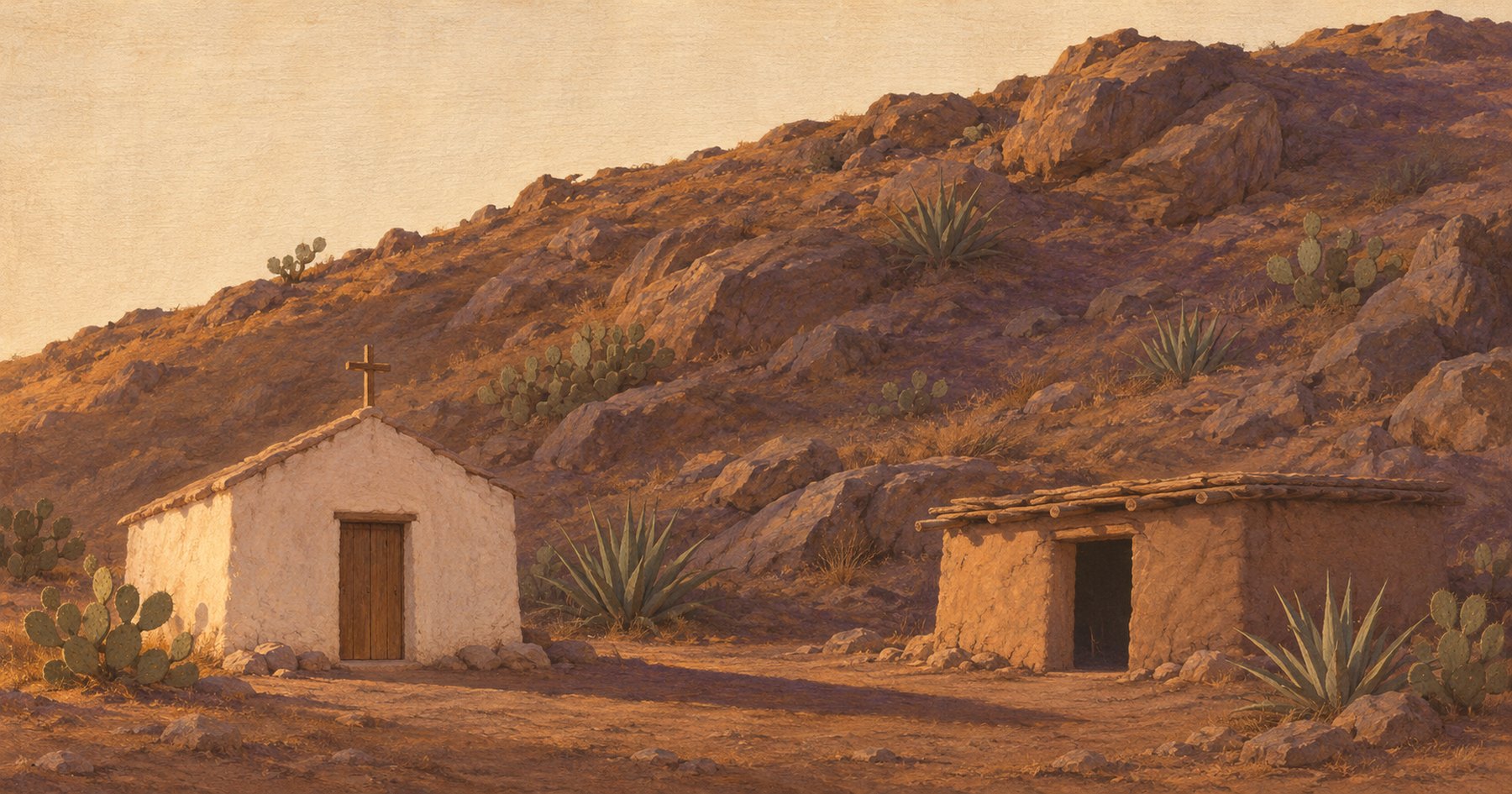
Nearly everything people know about him happened between December 9 and December 12, 1531. He lived another sixteen years after that. He spent them in a small house beside the chapel where the image hung, looking after it and telling the pilgrims who came what he had seen.
Before Tepeyac
Juan Diego was born in 1474 at Cuautitlán, a town north of the lake where the Aztec capital stood. His name was Cuauhtlatoatzin, made from the Nahuatl words for eagle and for speaking, and it is usually translated “the talking eagle” or “the eagle who speaks.” He was a commoner.
He was forty-five when the Spanish landed in Mexico in 1519, and forty-seven when the Aztec capital fell. The first twelve Franciscan missionaries arrived in 1524, and Juan Diego was baptized at about fifty, in the first years of their mission. His wife took the Christian name María Lucía.
An old Nahuatl account of his later life, the Nican Motecpana, printed in 1649 alongside the story of the apparitions, says that he and María Lucía lived together chastely, and that she died in 1529, two years before the Lady appeared on the hill. When the story begins, he was a widower in his late fifties, walking many miles to Mass and instruction with the Franciscans at Tlatelolco.
Four days in December
The story of what happened on the hill of Tepeyac is told in full in our article on Our Lady of Guadalupe. In short: on December 9, 1531, on his way to Mass, he met a young woman on the hill who told him she was the Virgin Mary and sent him to ask the bishop for a church on that spot. The bishop doubted him and asked for a sign. On December 12, on his way to find a priest for his dying uncle, Juan Bernardino, he met her again. She told him his uncle was already well and sent him to the top of the hill, where he found roses blooming in December. He carried them to the bishop in his tilma, and when he let it fall open, the image was on the cloth.
The Nahuatl account of those days, the Nican Mopohua, has a detail that is easy to lose in English. When the Lady speaks to him, she calls him “Juantzin, Juan Diegotzin.” Nahuatl speakers added the ending -tzin to a name to show love and respect, so her words come out something like “my dear Juan, my dear Juan Diego.” He had told her he was only a poor man. She spoke to him as someone dear to her.
The house beside the chapel
The bishop had a small chapel built for the image at the foot of the hill, and Juan Diego asked to live beside it. With the bishop’s permission, the old account says, he left his own house and fields to his uncle and moved into a little house next to the chapel.
He stayed there for the rest of his life. He cared for the chapel and the image, and for the pilgrims, who came in greater numbers every year. Many of them were his own people, and they heard the story in their own language, from the man it had happened to. The biography the Vatican published for his canonization says that from then on he gave his life to prayer, to the practice of virtue, and to the love of God and neighbor.
His uncle, Juan Bernardino, died on May 15, 1544, at eighty-six, during an epidemic, and was buried in the chapel. Juan Diego died in 1548, at about seventy-four, after sixteen years at the chapel. It was the same year that Bishop Zumárraga died, the man to whom he had first carried the Lady’s message. He was buried in the chapel too.
The first chapel was replaced long ago by the larger churches that followed. Near the basilica today stands a small church built in 1649, the old parish church of the Indians. By tradition, part of a wall of the first chapel is kept inside it, and nearby a cross marks the place where Juan Diego’s house stood.
“May God make you like Juan Diego”
In 1666, Church officials in Mexico took sworn testimony about the apparitions. Among the witnesses were old men and women of Cuautitlán, some said to be more than a hundred years old, who had grown up hearing about Juan Diego from their parents, grandparents, aunts and uncles.
Marcos Pacheco, who had twice been mayor of the town, described him, in our translation from the Spanish of the record, as “an Indian who lived an honest and recollected life, a very good Christian who feared God.” His aunt, he said, often told him, “May God make you like Juan Diego and his uncle,” because she held them to be very good Indians and very good Christians. Another witness called Juan Diego a holy man, and another said that many people had gone to the hermitage to ask him to pray for them.
More than a century after his death, that is how the people of his own town remembered him: a good Christian, a man you could ask to pray for you, the kind of man you hoped your children would grow up to be.
How he became a saint
Devotion to Juan Diego is centuries old, but the Church’s formal process for him moved forward only in the twentieth century. On May 6, 1990, on his second visit to Mexico, Pope St. John Paul II beatified him at the Basilica of Our Lady of Guadalupe.
To be canonized, he needed a miracle. In May 1990, in the days of the beatification, a young man in Mexico City named Juan José Barragán Silva threw himself from a balcony. He fell about thirty feet and struck the concrete head first. His mother, who had tried to hold on to him, entrusted him to God and to Our Lady as he fell, and asked Our Lady to listen to Juan Diego. He was taken to the hospital with grave injuries to his head, and the doctors did not expect him to live. Within three days he was well, with no lasting harm.
The doctors who examined the case for the Church could find no medical explanation, and in December 2001 John Paul II approved it as a miracle granted through Juan Diego’s prayers. In the 1990s, while his cause was under way, some historians questioned whether Juan Diego had existed at all, and the Holy See had a commission of historians examine the evidence again. It concluded in his favor, as our Guadalupe article tells.
On July 31, 2002, John Paul II, eighty-two years old and very frail, came to Mexico for the last time and canonized Juan Diego in the basilica at Tepeyac. In his homily he spoke of Juan Diego as a man who took the Christian faith to heart without giving up who he was as an Indigenous man. He was canonized a short walk from the place where he had lived and died.
His feast
St. Juan Diego’s feast is December 9, the day of the first meeting on the hill. It is an optional memorial on the Church’s calendar. In 2026 it falls on a Wednesday, the day after the Immaculate Conception and three days before Our Lady of Guadalupe. Those who pray the novena to Our Lady of Guadalupe, from December 3 to 11, reach his feast in the middle of it.
At the end of his homily at the canonization, John Paul II prayed to him. In our translation from the Spanish:
Beloved Juan Diego, “the eagle who speaks”! Teach us the way that leads to the dark-skinned Virgin of Tepeyac, so that she may receive us into the depths of her heart, for she is the loving and compassionate Mother who leads us to the true God. Amen.
A saint like this, every month
This is the sort of story in every issue of Saints by Mail: printed, reverent, and mailed to your door. A thoughtful gift for godchildren, families, and anyone who loves the saints.