St. Lucy, the Martyr of Syracuse, and Her Festival of Light
She was a young Christian of Syracuse, killed in the last great persecution. Her name comes from the Latin word for light, and her feast falls in the darkest weeks of the year.
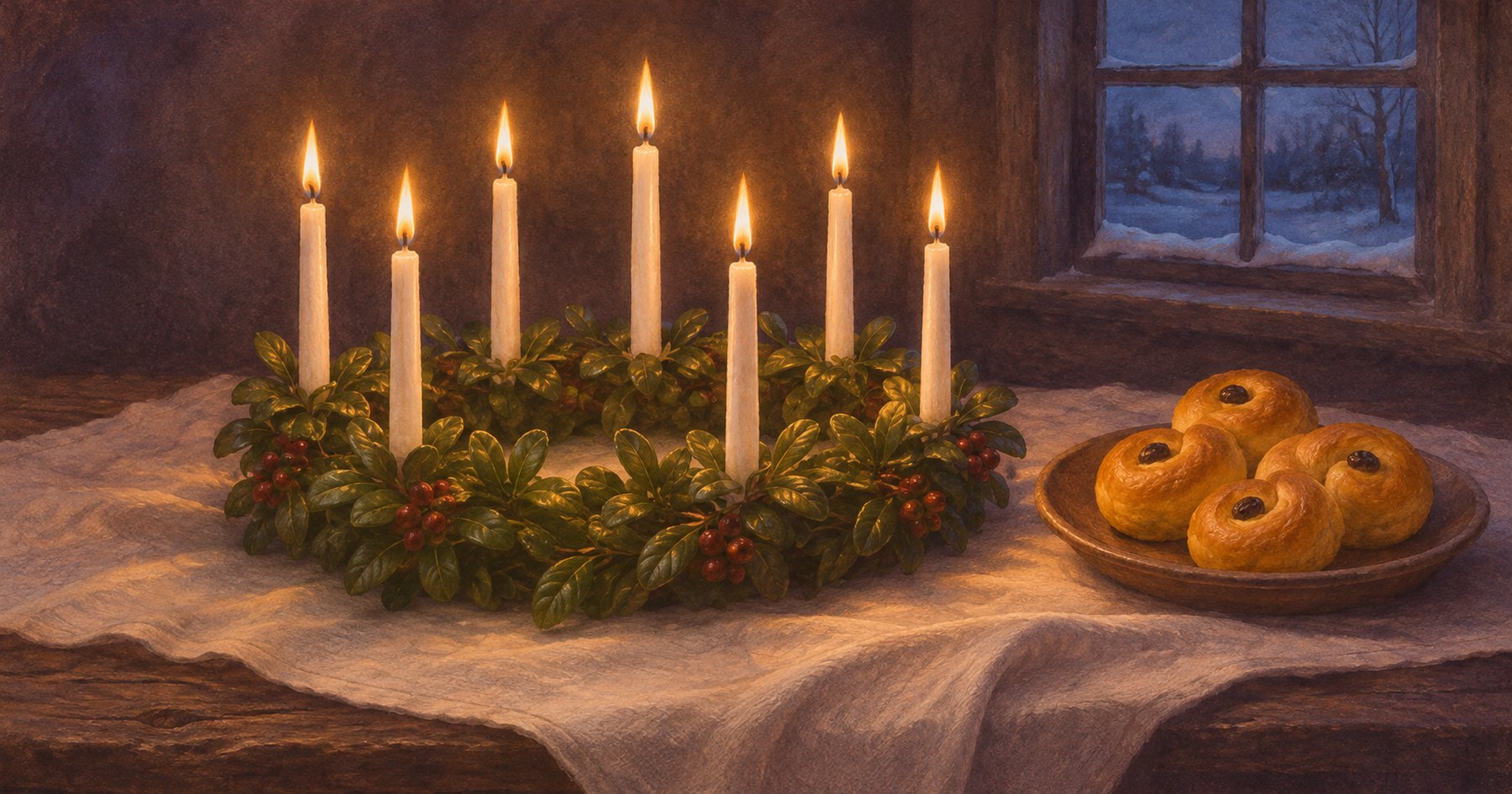
Before dawn on December 13, in homes all over Sweden, the eldest daughter gets up in the dark, puts on a white dress with a red sash and a crown of lit candles, and carries coffee and saffron buns to the rest of the family. In Sicily, people eat boiled wheat instead of bread that day. In parts of northern Italy, children go to bed on the night of December 12 hoping to find presents in the morning.
All of it is for St. Lucy, a young woman of Syracuse, in Sicily, who was martyred around the year 304. She is the patron saint of the blind and of anyone with trouble with their eyes. Her name, Lucia, comes from the Latin word for light.
What is known about her
Lucy died in her own city, Syracuse, in the persecution of the emperor Diocletian, the last great persecution under Rome. Tradition gives the year as 304.
The oldest evidence of her comes from her own city. In the catacomb of St. John at Syracuse, archaeologists found the gravestone of a young woman named Euskia, carved in Greek in the late 300s or early 400s. Euskia lived to about twenty-five, it says, and died “on the feast of my lady Lucy,” in our translation from the Greek. Within about a century of her death, the Christians of Syracuse were keeping Lucy’s day and dating their own deaths by it.
From Sicily her feast spread. By the 500s she was in the great mosaic procession of virgin martyrs in the church of Sant’Apollinare Nuovo in Ravenna, and soon after in the prayers of the Mass at Rome. She is one of the seven women martyrs named in the Roman Canon, the first Eucharistic Prayer: Felicity, Perpetua, Agatha, Lucy, Agnes, Cecilia, Anastasia. Her feast is kept on December 13, which tradition holds was the day she died.
The story of her life
The full story of Lucy’s life comes from an account of her martyrdom written down perhaps two hundred years after she died. As with most of the early martyrs, historians cannot check its details. It is the story the Church has told on her feast ever since.
Lucy, it says, came from a wealthy family of Syracuse. Her father died when she was young, and she grew up with her mother, Eutychia. Lucy had privately promised her life to God, but her mother, not knowing, arranged for her to marry a young pagan.
Eutychia had suffered for years from a hemorrhage. About fifty miles up the coast, at Catania, was the tomb of St. Agatha, a young martyr killed some fifty years before, and pilgrims were reporting cures there. Lucy took her mother to pray at the tomb. While they prayed, Agatha appeared to Lucy in a dream. Why, she asked, did Lucy come to her for what Lucy’s own faith could obtain? Her mother was healed. And as Agatha was the glory of Catania, Lucy would be the glory of Syracuse.
Eutychia was cured, and Lucy persuaded her to give away the fortune set aside for Lucy’s dowry now, to the poor, instead of leaving it to them at her death. What you give away at death, Lucy told her, you give because you cannot take it with you.
When the young man Lucy was to marry heard that her fortune was being given away, he denounced her as a Christian to Paschasius, the governor. She refused to offer sacrifice to the gods, and Paschasius ordered her taken to a brothel. The guards could not move her. They tied ropes to her and hitched her to a team of oxen, and still she would not move. They heaped wood around her and set it on fire, and the fire did not harm her. Finally a soldier killed her with a sword through her throat. She lived long enough, the story says, to receive Communion before she died.
Why she carries her eyes
In paintings, Lucy often holds a little dish with two eyes on it. That detail is not in the old account of her martyrdom. It appears much later, by the 1400s, in two versions. In one, the governor had her eyes put out. In the other, a suitor admired her eyes, so she took them out and sent them to him. In both, God restored her sight.
Most likely the devotion came first, from her name, and the stories grew around it. Lucy’s name means light, and people losing their sight have long prayed to her. She is the patron of the blind, of anyone with eye trouble, and of eye doctors.
Dante gave her an important part in the Divine Comedy. At its start, Mary sends Lucy to Beatrice, so that Beatrice will send help to Dante, lost in a dark wood. Dante calls her, in our translation, “the enemy of everything cruel.” Later, Lucy carries him in his sleep up the mountain of Purgatory to its gate, and at the end of the poem she has her place among the blessed in heaven.
The shortest day
For centuries, Lucy’s feast was the shortest day of the year. The old Julian calendar ran a little slow, and by the 1300s it had drifted so far that the winter solstice fell around December 13. The English poet John Donne wrote a poem for her feast in the early 1600s and called it “A Nocturnal upon St. Lucy’s Day, Being the Shortest Day.” It begins:
‘Tis the year’s midnight, and it is the day’s,
Lucy’s, who scarce seven hours herself unmasks
The Gregorian calendar of 1582 moved the solstice back to around December 21. Sweden did not change calendars until 1753, and there her day is still remembered as the longest night of the year.
Lucia in Sweden
Sweden has been Lutheran since the 1500s, and it still keeps St. Lucy’s day, and keeps it with more ceremony than almost anywhere else.
In the home, the Lucia is usually the eldest daughter. She wears a white dress, for baptism, a red sash, for martyrdom, and a crown of lingonberry leaves with lit candles. She brings the family coffee and lussekatter, S-shaped saffron buns with raisins. In schools, churches, offices and nursing homes, a Lucia leads a procession of girls in white carrying candles, and boys in white with cone-shaped hats and stars on sticks, all singing. The custom is old in parts of Sweden, but it spread across the country after 1927, when a Stockholm newspaper chose a Lucia for the city.
One of the songs sung in the procession is set to the Neapolitan tune “Santa Lucia.” The Italian song is not about the saint at all. It is a boatman’s song about the waterfront district of Naples called Santa Lucia, which took its name from her church there.
Lucy in Italy
In Syracuse, on December 13, a silver statue of Lucy with her relics is carried from the cathedral through the streets to the church built over the place where she was buried, and brought back a week later. Caravaggio painted The Burial of St. Lucy for that church in 1608.
Sicilians tell of a famine that ended on her feast, when ships loaded with grain came into the harbor. The people were too hungry to grind it into flour, the story goes, so they boiled the wheat whole. In memory of it, many Sicilian families eat no bread or pasta on December 13. They eat cuccìa, boiled wheat berries, usually sweetened with ricotta and honey.
In Verona, Bergamo, Brescia and other towns of northern Italy, Lucy brings the Christmas presents. She comes on the night of December 12, riding a donkey, a week after St. Nicholas visits the children of other countries. Children leave out coffee for her and hay or a carrot for the donkey. They must not try to watch her come, or she will throw ashes in their eyes.
In Hungary and Croatia, families plant wheat seeds in a dish on her feast. By Christmas the wheat stands green and tall, and it is set by the crib.
Her body in Venice
The history of her relics is tangled, and several cities have claimed them. Most of her body has been in Venice since the 1200s, and for centuries it rested in a church of Santa Lucia near the Grand Canal. In 1861 that church was torn down to make room for the city’s new railway station, which is why the main station in Venice is still called Santa Lucia. Her body was moved a few steps away, to the church of San Geremia, where it lies today.
In 1955 the Patriarch of Venice, Angelo Roncalli, who became Pope St. John XXIII, had a silver mask placed over her face. In November 1981, thieves broke in and stole her body, all but the head. Five weeks later, the police found it in a bag outside the city, on December 13, her feast day.
Syracuse has kept some of her relics since ancient times. The Caribbean island of Saint Lucia is named after her too.
Her feast
St. Lucy’s feast is December 13, a memorial on the Church’s calendar, in the middle of Advent. People with failing eyes, and those who love them, still ask her prayers.
Her day falls in the darkest weeks of the year, twelve days before Christmas, when the Church will read the Gospel of John: “That was the true light, which enlighteneth every man that cometh into this world.” In Sweden and Sicily and Venice, the people who keep her feast light candles for her while they wait for him.
A saint like this, every month
This is the sort of story in every issue of Saints by Mail: printed, reverent, and mailed to your door. A thoughtful gift for godchildren, families, and anyone who loves the saints.