St. Cecilia, the Patron Saint of Music, and the Song in Her Heart
She was a young Roman martyr whose name is still said at Mass in the Roman Canon. One line in the story of her wedding made her the patron saint of music.
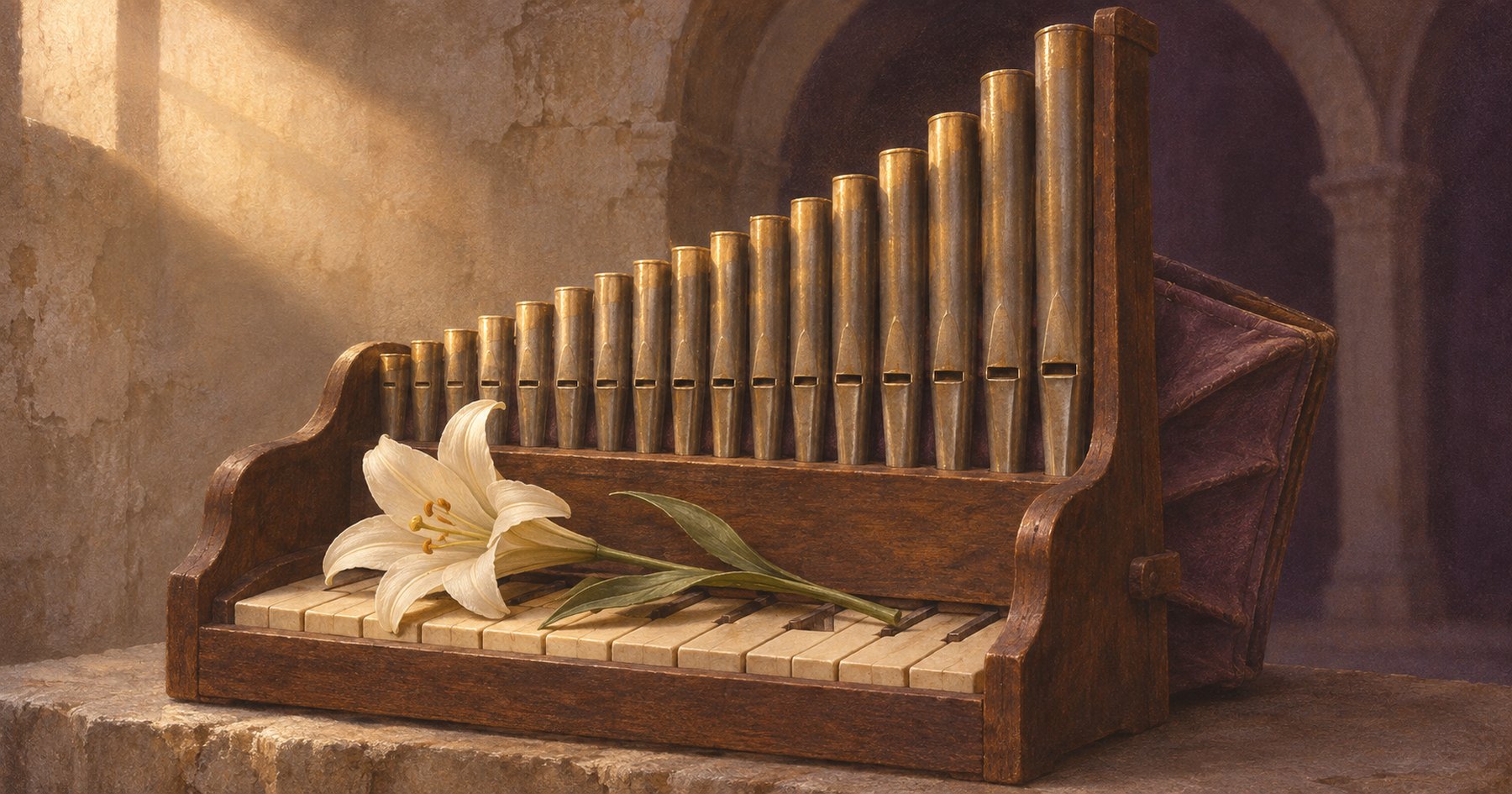
Musicians have a patron saint. She is St. Cecilia, a young Roman woman martyred in the early centuries of the Church, and her feast is November 22. Choirs sing for her, music schools and parish choirs are named for her, and in paintings she is nearly always at an organ.
The oldest account of her life never has her play a note. It tells how, on her wedding day, while the musicians played, she sang in her heart to God alone.
What is known about her
Cecilia is one of the best-loved martyrs of Rome, and one of the hardest to date. She died sometime between the late 100s and the middle of the 200s. Her tomb was in the Catacomb of St. Callixtus on the Appian Way, in a crypt right beside the one where the popes of the third century were buried, a place of great honor.
By the end of the 400s a church in her name stood in Trastevere, the district of Rome across the Tiber. It appears in the records of a Roman synod in 499 as the “title of St. Cecilia,” and tradition holds that it was built over her house. Her feast was being kept there in 545, when, according to the Book of the Popes, Pope Vigilius was celebrating it in her church and an officer of the emperor arrived, arrested him, and took him away to a ship on the Tiber before the service was over.
Her name is in the Roman Canon, the first Eucharistic Prayer, among the seven women martyrs the priest names after the consecration: Felicity, Perpetua, Agatha, Lucy, Agnes, Cecilia, Anastasia. Catholics have been hearing her name at Mass for well over a thousand years. Like the other martyrs of the early Church, she was honored as a saint by the Christians who knew her story, long before there was a formal process for it.
The story of her wedding and her death
The full story of her life was written down in the fifth century, two hundred years or more after she died. Like many accounts of the early martyrs, it was written to be read aloud on her feast, and historians cannot check most of its details. It is the story the Church has told about her ever since, and the one behind all the paintings.
Cecilia, it says, was a girl of a noble Roman family, raised a Christian, who had promised her virginity to God. Her parents married her to a young pagan nobleman named Valerian. At the wedding, while the musicians played, she sang in her heart to the Lord alone.
That night she told Valerian that an angel of God watched over her and would guard her against anyone who violated her. Valerian asked to see the angel. Cecilia told him to go out along the Appian Way to the third milestone, where he would find Bishop Urban, and be baptized. He went, and was baptized, and when he came home the angel appeared to them both and crowned them with garlands of roses and lilies. The roses are usually read as martyrdom and the lilies as purity.
Valerian’s brother Tiburtius became a Christian too. The two brothers gave alms and buried the bodies of the martyrs, and the prefect of Rome, Almachius, had them put to death. Maximus, the officer sent to carry out the sentence, was converted by them and died with them, and Cecilia buried all three.
Then the prefect’s men came for her. She was sentenced to be suffocated in the steam bath of her own house, and when she came through the heat unharmed, a soldier was sent to behead her there. He struck her neck three times without cutting off her head, and the story says the law allowed no fourth stroke, so he left her where she lay. She lived three days. She gave what she had to the poor, and asked Bishop Urban to make her house a church. He buried her among the bishops, in the catacomb on the Appian Way.
Valerian, Tiburtius and Maximus were real martyrs too, buried in another catacomb along the same road.
How she became the patron of music
The line that made her the patron of music is the one about her wedding. In the Latin of her story it reads cantantibus organis, illa in corde suo soli Domino decantabat: while the instruments played, she sang in her heart to the Lord alone. The Church made it an antiphon for her feast, which in our translation reads:
While the instruments played, the virgin Cecilia sang in her heart to the Lord alone: Lord, let my heart and my body be undefiled, that I may not be confounded.
Her prayer comes from the psalms: “Let my heart be undefiled in thy justifications, that I may not be confounded.”
The Latin word organa meant musical instruments of any kind. Over the centuries it came to mean the organ in particular, and by the 1400s painters were showing Cecilia playing one herself. The song in her heart became music people could hear, and the bride who kept her mind on God while the wedding music played became the saint of music.
In 1585 Pope Sixtus V founded a congregation of musicians in Rome under the patronage of St. Gregory the Great and St. Cecilia. Palestrina was among its musicians in its early years, and it still exists today as the Accademia Nazionale di Santa Cecilia, one of the oldest musical institutions in the world.
Around 1516 Raphael painted her for a church in Bologna. She holds a small organ tipped downward in her hands, with broken instruments lying at her feet, and looks up at a choir of angels singing in the clouds above her.
In England, musicians held concerts on her feast from the 1680s. John Dryden wrote “A Song for St. Cecilia’s Day” in 1687, and Handel set it to music for her feast in 1739. Near the end it turns to her at the organ:
But bright Cecilia raised the wonder higher:
When to her organ vocal breath was given,
An angel heard, and straight appeared,
Mistaking earth for heaven.
Benjamin Britten, who was born on her feast day in 1913, wrote his Hymn to St. Cecilia in 1942.
Found again
In the 820s, Pope Paschal I rebuilt her church in Trastevere and wanted to bring her body there, but he could not find it and came to believe it had been stolen. According to the account of the finding, Cecilia appeared to him in a vision and told him he had already been very close to her. He searched again and found her body, wrapped in cloth of gold, with cloths soaked in her blood laid at her feet. He placed her under the high altar of her church, with Valerian, Tiburtius and Maximus, and the popes Urban and Lucius. The mosaic he put in the apse is still there, and Paschal himself is in it, holding a model of the church.
Nearly eight hundred years later, in October 1599, Cardinal Paolo Emilio Sfondrati was restoring the church for the Jubilee of 1600, and he had the space beneath the altar opened. His workmen found the coffins Paschal had placed there. The witnesses, among them the scholar Antonio Bosio, described Cecilia’s body lying whole on its right side, as if asleep, under a silk veil stained with blood. Out of reverence, no one lifted the veil from her face. Her remains were set out in the church, crowds came to see her, and Pope Clement VIII came himself. On her feast, November 22, 1599, she was laid back beneath the altar.
Sfondrati asked a young sculptor, Stefano Maderno, then about twenty-three, to carve her as she had been found. His white marble statue lies in a niche under the high altar today. She is on her side, her arms stretched out in front of her, her face turned down and away, and the three cuts of the sword can be seen on her neck. In the floor in front of it, Maderno’s own words are carved in Latin. In our translation:
Here is the image of the most holy virgin Cecilia, whom I myself saw lying whole in her tomb. In this marble I have shown her to you in exactly the same position.
Her church in Rome
Santa Cecilia in Trastevere still stands, with Paschal’s mosaic in the apse and Maderno’s statue under the altar. Beneath the church, excavations have uncovered the rooms of a Roman house, and a side chapel has long been shown to pilgrims as the bath where she was condemned to die.
Benedictine nuns have lived beside the church since 1527. Every year they shear the lambs blessed on the feast of St. Agnes, and from their wool they weave the pallium, the band of white wool the pope gives to new archbishops.
Her first tomb, in the Catacomb of St. Callixtus, is open to visitors. A copy of Maderno’s statue lies in the niche where she was buried.
The Church’s music
In the 1800s, Catholic musicians who wanted to bring Gregorian chant and the polyphony of Palestrina back into their churches organized themselves into Cecilian societies, named for her. The first was founded in Germany in 1868, and others followed across Europe and in America. A great many parish choirs still carry her name.
On her feast in 1903, Pope St. Pius X signed Tra le sollecitudini, his letter on sacred music. Translated from its Italian, it calls Gregorian chant “the supreme model of sacred music,” and it says the faithful draw the true Christian spirit from its “first and indispensable source, which is active participation in the most holy mysteries and in the public and solemn prayer of the Church.” The phrase “active participation,” which the Second Vatican Council took up sixty years later, is usually traced to this letter.
Her feast
St. Cecilia’s feast is November 22. When it falls on a Sunday, the Sunday Mass takes its place, but choirs and music schools keep her day anyway, with concerts and sung Masses, and many parish choirs mark it together. She is the patron of musicians, singers, organists, instrument makers and poets, and musicians ask her prayers before they audition or perform.
On her wedding day, with the musicians playing all around her, Cecilia sang in her heart to God alone. Church musicians have asked for her prayers ever since, for the grace to do the same.
A saint like this, every month
This is the sort of story in every issue of Saints by Mail: printed, reverent, and mailed to your door. A thoughtful gift for godchildren, families, and anyone who loves the saints.