Who Is St. Michael the Archangel, and Why Is His Name a Question?
Every other saint has a name. Michael has a question, and the question is the whole point.
Most names mean something flattering. Michael’s is an interrogative.
Mi-ka-El, in Hebrew, is not a description. It is a question with an implied answer, and the question is: who is like God?
Tradition has always taken that as his battle cry rather than his label. The oldest way of telling the story is that pride made a claim in heaven, and the answer to the claim was a question nobody could answer. Whatever you make of that, it is a remarkable thing to carry around as a name.
What Scripture actually says
Michael is one of three angels named in the Bible, alongside Gabriel and Raphael, whose feast he now shares. He appears four times, and the passages are shorter than his reputation suggests.
In the Book of Daniel he turns up three times. He is called one of the chief princes, he comes to the aid of another heavenly messenger who has been delayed, and he is named as the great prince who stands guard over Daniel’s people. That last one is the root of his oldest role: he is a guardian assigned to a nation.
In the letter of Jude there is one strange sentence about Michael disputing with the devil over the body of Moses and declining to bring a railing accusation against him, saying only that the Lord rebuke him. Jude is referring to a story from a book that is not in the Bible, which is itself worth noticing: the writer expected his readers to know it.
And in Revelation, the line everyone knows. War broke out in heaven. Michael and his angels fought against the dragon.
That is the whole scriptural file. Four appearances, one of them borrowed from a book the Church never canonized. Everything else about him, and there is a great deal of it, grew afterward.
A curiosity about rank
In the traditional scheme of the nine choirs of angels, which comes to us through a sixth-century writer usually called Pseudo-Dionysius, archangels are not near the top. They are eighth of nine, second from the bottom.
Which means the commander of the armies of heaven holds, on paper, an almost junior rank.
Nobody in the tradition seems bothered by this. The title describes what he does, which is carry messages and fight, rather than where he sits in a hierarchy worked out centuries later by somebody trying to be systematic about a subject that resists it.
When Michaelmas ran the year
Here is the part that has nothing to do with theology and is the reason his name is all over the English-speaking world.
September 29 was Michaelmas, and in England it was one of the four quarter days: the dates on which rents fell due, accounts were settled, debts were called in, servants were hired, and leases began and ended. The others were Christmas, Lady Day in March, and Midsummer in June.
It was, in practical terms, a fiscal deadline with a feast attached. It fell at the close of the harvest, when there was finally money to pay with, which is why it landed there.
The residue is everywhere. Oxford, Cambridge, and Dublin still call the autumn term Michaelmas term. The purple asters flowering around now are Michaelmas daisies. And there is a folk rule, kept seriously in parts of Britain and Ireland well into living memory, that you do not pick blackberries after Michaelmas, because when the devil was thrown out of heaven he landed in a bramble bush and spat on it. The berries do go over around then, which is presumably how the story earned its keep.
The mountain in Puglia
The oldest shrine to Michael in western Europe is on Monte Gargano, the spur of rock that sticks out into the Adriatic from the heel of Italy. A sanctuary has been there since the fifth century, built into a cave, and it drew pilgrims for over a thousand years before most of the famous shrines existed.
Along the same mountain is San Giovanni Rotondo, where Padre Pio spent fifty-two years, and he is supposed to have told visitors that a trip to see him was not complete without going up to see Michael. The two shrines still trade pilgrims back and forth.
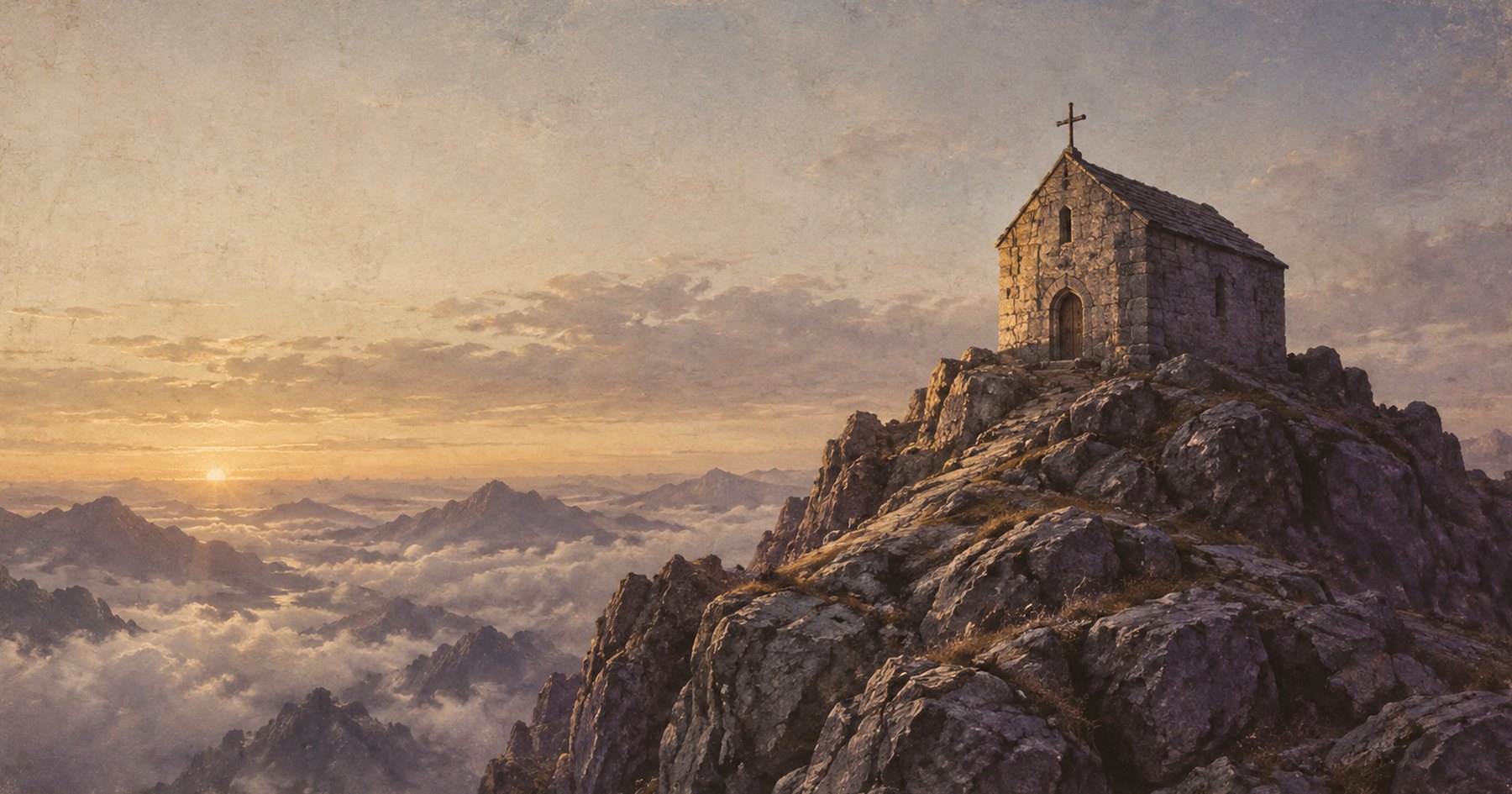
Mont-Saint-Michel in Normandy and St Michael’s Mount in Cornwall are the same idea in a different landscape. Michael gets high places. It is consistent enough across centuries and countries that it reads less like a coincidence than like an instinct.
The prayer
In 1886 Leo XIII composed a short prayer asking Michael to defend us in battle, and ordered it said at the end of Low Mass throughout the Church. It stayed there for nearly eighty years, so several generations of Catholics knew it by heart without ever deciding to learn it.
The requirement was dropped in 1964 during the liturgical reforms. It has come back widely since, said after Mass in a great many parishes by local custom rather than by rule, which is roughly how it started.
Who asks for him
Soldiers and police officers, paramedics and mariners, and anybody in a job where the danger is real rather than notional. Grocers too, oddly, from the old images of him holding a set of scales.
And the dying. This is his quietest patronage and probably his oldest. The old funeral liturgy asked that Michael, the standard-bearer, bring the soul into the holy light, and the image behind it is not a warrior but an escort: somebody whose job is to make sure you are not walking into the dark by yourself. If you have been to a Catholic funeral you have likely heard some version of it without catching the name.
It pairs with the other end of that fortnight in the calendar. The feast for grief is for the people left behind. Michael is for the one who has gone.
September 29
Before 1969 he had the day to himself. In the revision of the calendar it became the feast of Michael, Gabriel, and Raphael together, the three the Bible names, which is tidier and costs Michael a little of his standing.
He has not obviously suffered for it. There are more churches, hospitals, schools, and children named for him than for almost any other figure in the calendar, and the name is still doing the same thing it did at the start. Somebody says it, and a question gets asked, and the answer is nobody.
A saint like this, every month
This is the sort of story in every issue of Saints by Mail: printed, reverent, and mailed to your door. A thoughtful gift for godchildren, families, and anyone who loves the saints.