The Story of St. Monica, the Patron Saint of Mothers Who Wait
She is one of the best documented women of the fourth century, and the reason is that her son happened to be a genius.
Almost nothing survives about ordinary women in the Roman provinces of the fourth century. They were born, they married, they raised children, they died, and the record closes over them without a ripple. We do not have their names.
We have Monica’s, in detail, including what she drank as a girl and what she said on her deathbed, because her son wrote a book. He was Augustine of Hippo, the book was the Confessions, and it is one of the most closely read works in Western literature. She is in it constantly.
That is the first thing worth understanding about St. Monica. She is not a saint we know through legend or through a shrine tradition. She is a saint we know through a named contemporary eyewitness of extraordinary literary power who happened to be her child.
Thagaste
She was born around 331 in Thagaste, a town in Roman North Africa, in what is now Algeria. Her family was Christian and Berber. Her name may come from a local African deity, which is the sort of detail that tells you how mixed that world was.
She was married off to Patricius, a town official who was not a Christian, who had a temper, and who was unfaithful to her. Augustine says his mother handled him partly by learning when not to speak, and that she was notable among the local wives for never showing the bruises they showed, because her husband did not beat her. That is his way of praising her, and it also tells you what was ordinary in Thagaste.
Near the end of his life Patricius was baptized. He died around 371. They had three children who lived: Augustine, another son, and a daughter.
The wine in the cellar
Here is why the Confessions is such an unusual source.
Augustine tells a story about his mother as a girl, sent to draw wine from the cask for the household. She began taking sips. The sips became mouthfuls, then most of a cup, a day at a time, until a servant girl she had quarreled with called her a drunkard to her face. The insult landed. She stopped.
A hagiographer inventing a saintly mother does not put that in. It survives because her son thought it mattered, and because he was writing a book about how grace works on actual people rather than a book about how admirable his family was. It is also why she is invoked by people fighting a drinking problem.
Seventeen years
The central fact of her life, and the reason anyone prays to her, is that she spent roughly seventeen years watching her brilliant son go the wrong way and being unable to do anything about it.
Augustine left the faith she raised him in. He joined the Manichees, a rival religion she found repellent, and would not let him eat at her table for a while because of it. He chased status as a teacher of rhetoric. He took a woman he never married and had a son with her. He was, by his own later account, ambitious and evasive and not much interested in his mother’s grief.
She wept, and pestered clergy about him, and would not stop. One bishop, worn down, told her a line that has outlived everyone in the room: it is not possible that the son of these tears should perish.
Then he tricked her. Wanting to leave Carthage for Rome without a scene, Augustine told her he was only seeing a friend off at the harbor, waited for her to go and pray in a chapel by the shore, and sailed in the night. She woke to find him gone.
She followed him anyway. To Rome, and then to Milan, where she attached herself to the congregation of Ambrose, who was the one person in the story able to out-argue her son.
Augustine converted in 386 and was baptized at Easter in 387. She had been waiting most of his adult life.
Ostia
They set out to go home to Africa together and got as far as Ostia, the port of Rome, where they had to wait for a ship.
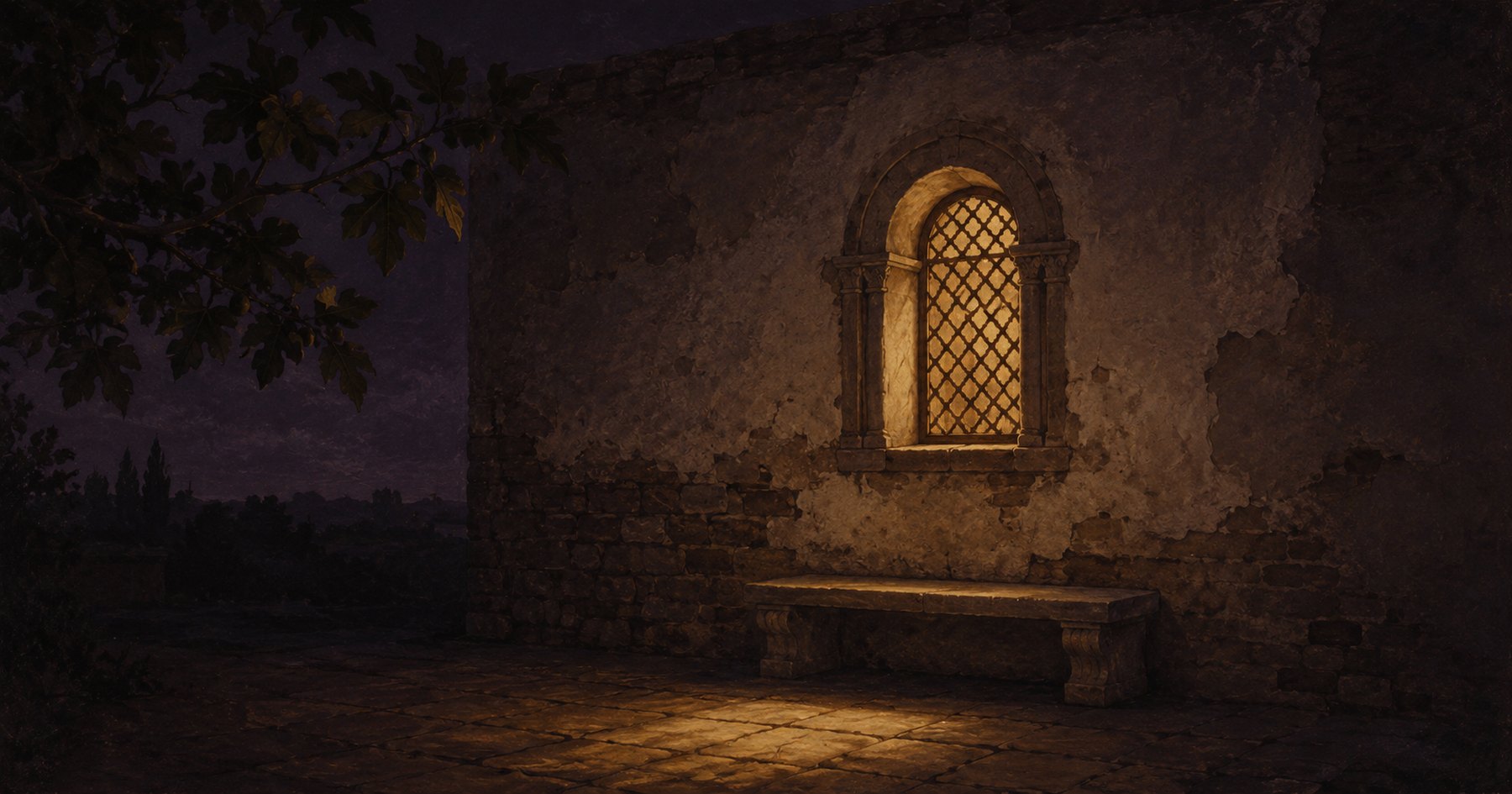
There, standing at a window looking onto a garden, mother and son had a conversation that Augustine later tried to write down and admitted he could not properly render: the two of them reasoning their way upward through created things toward God and, for a moment, arriving. It is one of the most famous passages in the book, and what makes it remarkable is the company. It is not a solitary mystic in a cell. It is a middle-aged woman and her adult son, talking.
She fell ill a few days later and died within about nine days, aged fifty-six. She had always wanted to be buried at home beside her husband. At the end she told her sons not to bother: bury this body anywhere, she said, and do not trouble yourselves about it. Only remember me at the altar of the Lord.
She is buried in Rome. Her remains were moved there in 1430 and lie in the church of Sant’Agostino.
What kind of evidence this is
Being honest about sources usually means admitting a record is thin. Monica is the opposite problem, and it is worth naming.
By the standards of fourth-century biography this is superb evidence: a named author, writing about a decade after the events, who was physically present for most of them and knew the subject better than anyone alive. Compare that with what can actually be established about Sts. Anne and Joachim, or with a saint reconstructed from three tiles and a vial, and Monica is on solid ground.
It is still one source, and an interested one. The Confessions is not a biography. It is a theological argument about grace, addressed to God, in which Monica plays a necessary part: she is the prayer that gets answered. Augustine is not lying, and he is also not neutral, and he is choosing which things about his mother to tell us and why. We see her almost entirely by his light.
That does not diminish her. It does mean the woman was certainly larger than the portrait, and that the parts of her that did not serve his argument are simply gone. Like most early saints she was never formally canonized; the process did not exist yet, and she was venerated by custom long before anyone thought to write rules.
Why her feast sits where it does
Her feast is August 27. That is recent. For centuries it was kept on May 4, and when the calendar was revised in 1969 she was moved to the day before her son’s, so that Monica comes on the 27th and Augustine on the 28th.
It is a small thing and a deliberate one. Whoever made that decision understood the story: she goes first, and he follows, which is how it happened.
Who asks for her
Mothers, mostly. She is the patron of wives in hard marriages, of women whose husbands are unfaithful, of people struggling with drink, and above all of parents praying for a child who has walked away from everything they hoped for.
That last one is why she still gets asked. The useful thing about Monica is not that her prayers were answered. It is that they were answered on a timescale of seventeen years, during which she had no way of knowing they would be. Anyone waiting on someone is in the part of the story she spent almost all of her life in.
A saint like this, every month
This is the sort of story in every issue of Saints by Mail: printed, reverent, and mailed to your door. A thoughtful gift for godchildren, families, and anyone who loves the saints.