The Story of Sts. Anne and Joachim, the Grandparents of Jesus
Their names are not in the Gospels. The Church has kept their memory for sixteen centuries anyway, and it has never pretended otherwise.
If you go looking for the grandparents of Jesus in the Bible, you will not find them. Matthew and Luke both trace Jesus’s lineage at length, and neither one names Mary’s mother or father. Yet the Church keeps their feast every July 26, churches and hospitals and whole towns carry the name St. Anne, and one of the largest pilgrimage shrines in North America is built around her. So where did Anne and Joachim come from?
The answer is more interesting than either of the easy versions, and the Church has never hidden it.
The names come from outside the Bible
Anne and Joachim are named in a document called the Protoevangelium of James, sometimes called the Infancy Gospel of James, written around the middle of the second century. It tells the story of Mary’s conception, birth, and childhood, and it gives her parents the names Joachim and Anna. In English that second name became Anne, or Ann.
That text is not in the Bible. It never was. The Church did not include it in the canon of Scripture, and it does not treat it as the word of God. What the Church did do is keep the names.
This is the part worth sitting with, because it is where a lot of writing about the saints gets slippery in one direction or the other. Nobody is claiming these names are scriptural. But it does not follow that they were invented out of nothing. Mary had a mother and a father. Someone raised her. A community that still had living memory of her family may well have carried their names forward in exactly the way families do, and a second-century writer may have written down what was already being said. The honest position is the one the Church has actually held: this is ancient tradition, cherished and very old, and it is not Scripture. Both halves of that sentence are true at once.
What the tradition tells
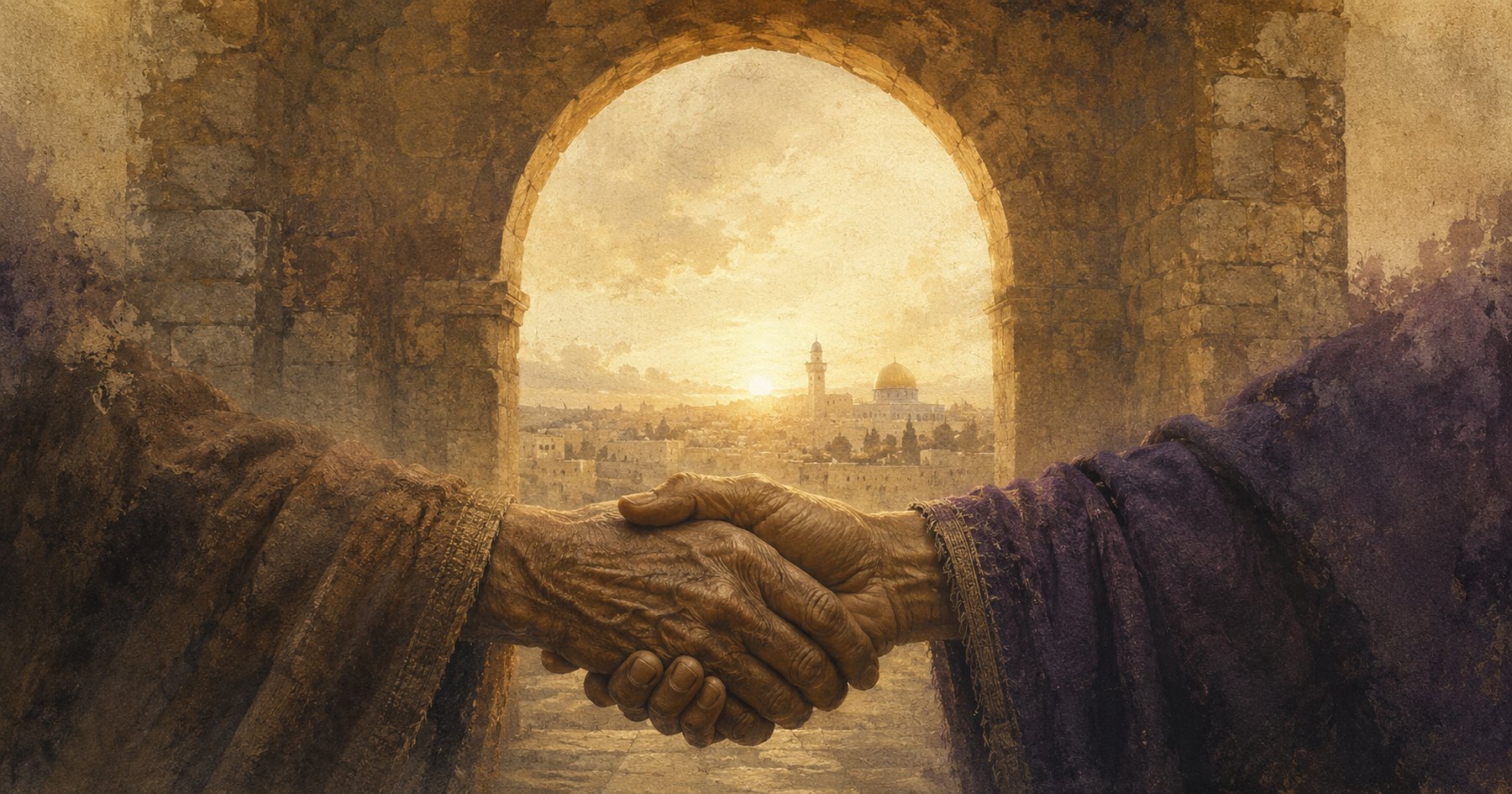
The story goes like this. Joachim and Anne were married for many years and had no children, which in their time and place carried real shame. Joachim’s offering was refused at the Temple because he was childless, and he went out into the wilderness to fast and pray. An angel came to each of them separately with the same news: they would have a child. They met again at the Golden Gate of Jerusalem, and Anne conceived. The daughter born to them was Mary.
Their meeting at the gate became one of the most painted scenes in Christian art. Giotto put the whole cycle on the walls of the Scrovegni Chapel in Padua around 1305, and it is still one of the most moving things in the building: two ageing people who had given up, embracing in a doorway.
It is a devotional story rather than a documented one, and telling it well means saying that plainly. It is also, as devotional stories go, an unusually kind one. It is about people who waited a long time.
Why the Church kept them
Devotion to Anne is genuinely ancient. She was venerated in the Christian East by the sixth century, well before anyone was keeping the kind of records a historian would want. Neither she nor Joachim went through anything like the modern canonization process, which did not exist yet; like most of the earliest saints, they were recognized by the faithful long before there was a procedure to recognize them. They are pre-congregation saints, honored by custom rather than by decree.
This puts them in the same category as St. Nicholas, another saint whose documentary record is thin and whose hold on ordinary people has never loosened. In both cases the devotion is the historical fact. You can date the churches. You can count the pilgrims.
In the 1969 revision of the calendar the two were given a single joint feast on July 26, which is where it sits today.
The patrons of grandparents
Anne is the patron of grandmothers, mothers, and women hoping for a child; Joachim of grandfathers and fathers. Together they are the patrons of grandparents, and that patronage is not a modern marketing idea. It follows directly from who they are in the story.
Pope Francis made the connection official in 2021 when he established the World Day for Grandparents and the Elderly, deliberately placing it on the fourth Sunday of July so it would fall near their feast. In 2026 the two landed on the same day, July 26.
Their shrines are worth knowing about if you ever get near one. Sainte-Anne-de-Beaupré, outside Quebec City, has drawn pilgrims since 1658 and is deeply woven into French Canadian and Mi’kmaq devotion. Sainte-Anne-d’Auray in Brittany has been a center of Breton faith for four centuries. Both are places where people bring the things families carry.
An old couple, still waiting up
There is something quietly reassuring about a Church that gives a feast day to two people it cannot fully document. It suggests an institution more interested in remembering the right people than in pretending to know more than it does.
If you have grandparents, or you are one, this is their day on the calendar. Anne and Joachim are the patrons of the long view: the ones who raise the child who raises the child, who mostly do not see how the story turns out, and who are honored anyway. That is worth a phone call, and it is a large part of why a good thing in the mail still means what it does to the people who taught us to open it.
A saint like this, every month
This is the sort of story in every issue of Saints by Mail: printed, reverent, and mailed to your door. A thoughtful gift for godchildren, families, and anyone who loves the saints.