The Story of St. Philomena, the Saint Who Was Taken Off the Calendar
She is the saint the Church stopped putting on its calendar, and never stopped allowing people to love.
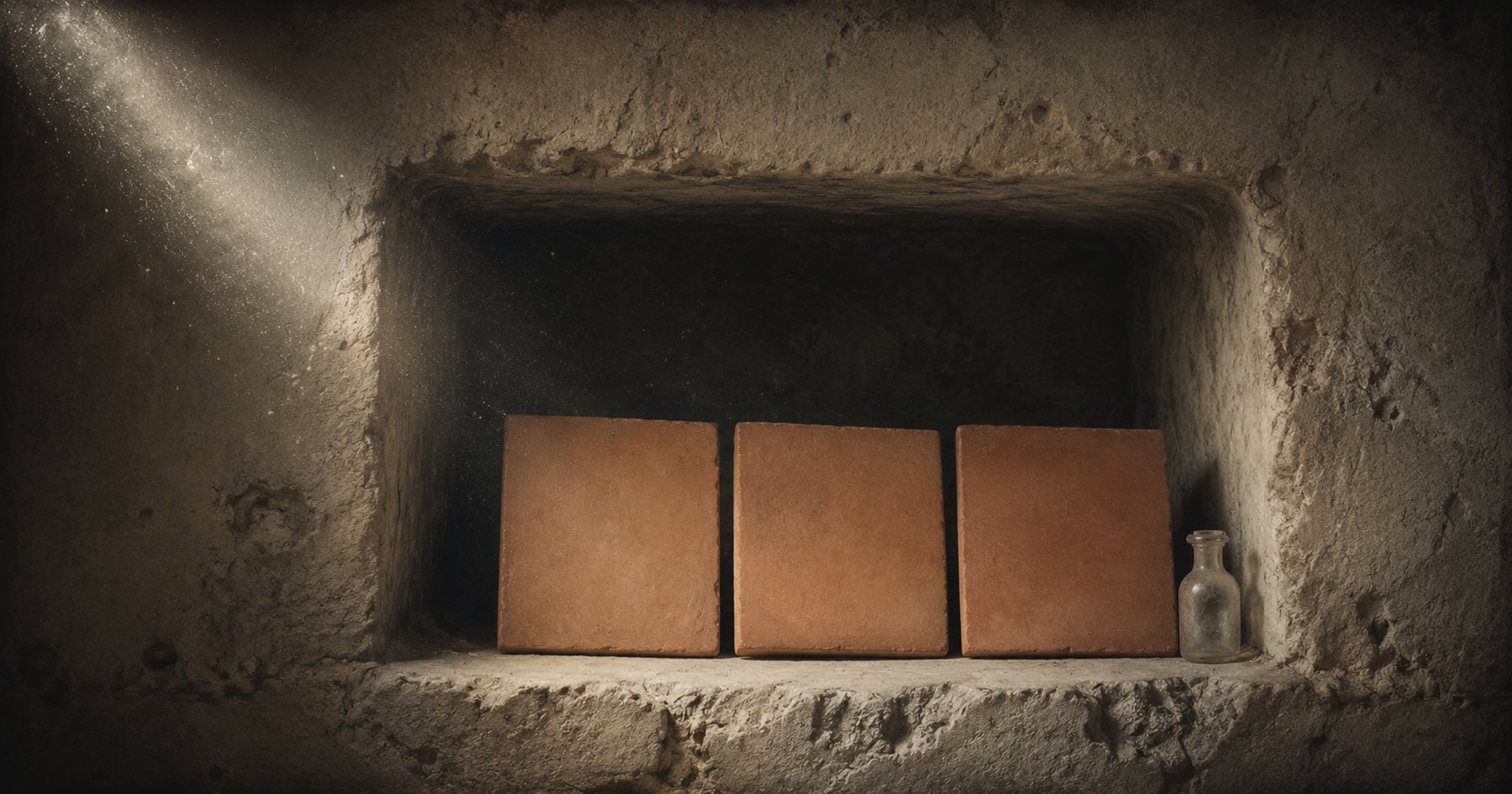
In May of 1802, workers excavating the Catacomb of Priscilla on Rome’s Via Salaria opened a sealed burial niche. Inside were the bones of a girl, perhaps thirteen or fourteen years old, and a small glass vial holding a dried reddish residue. Sealing the niche were three terracotta tiles, and on them an inscription broken across the pieces. Rearranged, the letters read PAX TECUM FILUMENA. Peace be with you, Philomena.
Nobody had ever heard of her. There was no account of her life, no mention in any martyrology, no tradition attached to the name. There was a girl’s skeleton, a vial, and a wish for peace.
What happened over the next two centuries is one of the strangest and most instructive stories in the Church’s calendar, and it is worth telling straight.
From a catacomb to a shrine
By the standards of the time, the find read clearly. A vial of what was taken to be blood, placed with a body in the catacombs, was widely understood as the mark of a martyr. The remains were treated accordingly.
In 1805 they were given to Don Francesco di Lucia, a priest from Mugnano del Cardinale, a small town inland from Naples. He brought them home and enshrined them. What followed was not gradual. Cures and answered prayers were reported almost immediately, the crowds grew, and within a generation the shrine at Mugnano had become one of the busiest in southern Italy.
Two people mattered enormously to what came next. One was St. John Vianney, the Curé of Ars, who became her most famous devotee. He built a chapel in her honor, credited her intercession with the cures that took place in his parish, and spoke of her constantly. The other was Pauline Jaricot, the founder of the Society for the Propagation of the Faith, who was gravely ill with heart disease and who recovered at the shrine in 1835. Her recovery was witnessed, it was dramatic, and it reached Rome.
A saint on the strength of miracles alone
In 1837 Pope Gregory XVI authorized her public liturgical veneration and set her feast on August 11.
Pause on how unusual that is. The Church’s process normally works from a life: you examine what a person did, how they lived, what they wrote, who knew them. Philomena had none of that. There was no biography to investigate because there was no biography. She was raised to the altars on the strength of the reported miracles and the devotion of the faithful, and essentially nothing else.
That is not a scandal, exactly. It is closer to how the very earliest saints were recognized, long before there was a procedure at all. But it left the whole edifice resting on a single assumption: that the girl in the niche was named Philomena and had died for the faith.
What the archaeology came to say
That assumption did not hold up well.
Archaeologists studying the catacombs came to think the three inscribed tiles had been reused. Their lettering and arrangement suggested they had originally sealed a different, earlier grave and were later repurposed to close this one, which would mean the name on them may not belong to the person found behind them. Separately, the older confidence about vials of blood was reconsidered. Vials turned up in graves that were not martyrs’ graves, and the contents were not always what they had been assumed to be.
None of that proves there was no Philomena. It means the evidence that the girl in that niche was a martyr named Philomena is a good deal thinner than it looked in 1802.
1961, and the thing everyone gets wrong
In 1961 the Sacred Congregation of Rites directed that her feast be dropped from liturgical calendars.
This is almost universally reported as “the Vatican de-canonized St. Philomena.” That is not what happened, and the distinction is worth getting right. Her name was removed from the calendar. She was not declared a fiction, her canonization was not reversed, and the shrine at Mugnano was not closed. It remains open. Devotion to her remains permitted. Pilgrims still come.
What the Church actually did was narrower and more honest than the rumor: it stopped asserting, in its official public worship, a historical identity it could no longer stand behind. It did not pronounce on what happened to Pauline Jaricot, or to the people at Ars, or to anyone else who prayed and believed they were heard. Those are different questions, and the Church treats them differently.
What to make of her
It would be easy to tell this story as a debunking, and easy to tell it as though nothing ever happened. Both would be lazy.
Here is what can actually be said. A girl was buried in a Roman catacomb, and someone who loved her wished her peace. Centuries later her remains were found and given a name that may not have been hers. Around that name grew a devotion that consoled enormous numbers of people, that a canonized saint staked his own parish on, and in which cures were reported that the Church took seriously enough to act on. Then scholarship caught up with the evidence, and the Church quietly adjusted what it claimed while leaving the devotion alone.
She is invoked as the patron of infants and young people, and in desperate cases, and in Italy she is called la Taumaturga, the Wonder-Worker. Like Sts. Anne and Joachim, whose names also come to us from outside the historical record, what is documented about her is small and what has been built on her is very large.
A Church willing to take a name off its own calendar, and equally unwilling to tell grieving people that their prayers went nowhere, is doing something harder than either certainty or dismissal. Her feast is still kept at Mugnano on August 11.
A saint like this, every month
This is the sort of story in every issue of Saints by Mail: printed, reverent, and mailed to your door. A thoughtful gift for godchildren, families, and anyone who loves the saints.